In Production
UX Strategy
lead generation
A Straight Answer, Up Front
A Chicago remodeling company that leads with the price instead of making people wait for it. I own the entire digital product: the story of designing it, hitting the ceiling of the no-code tools, and rebuilding it as real software to keep that promise.
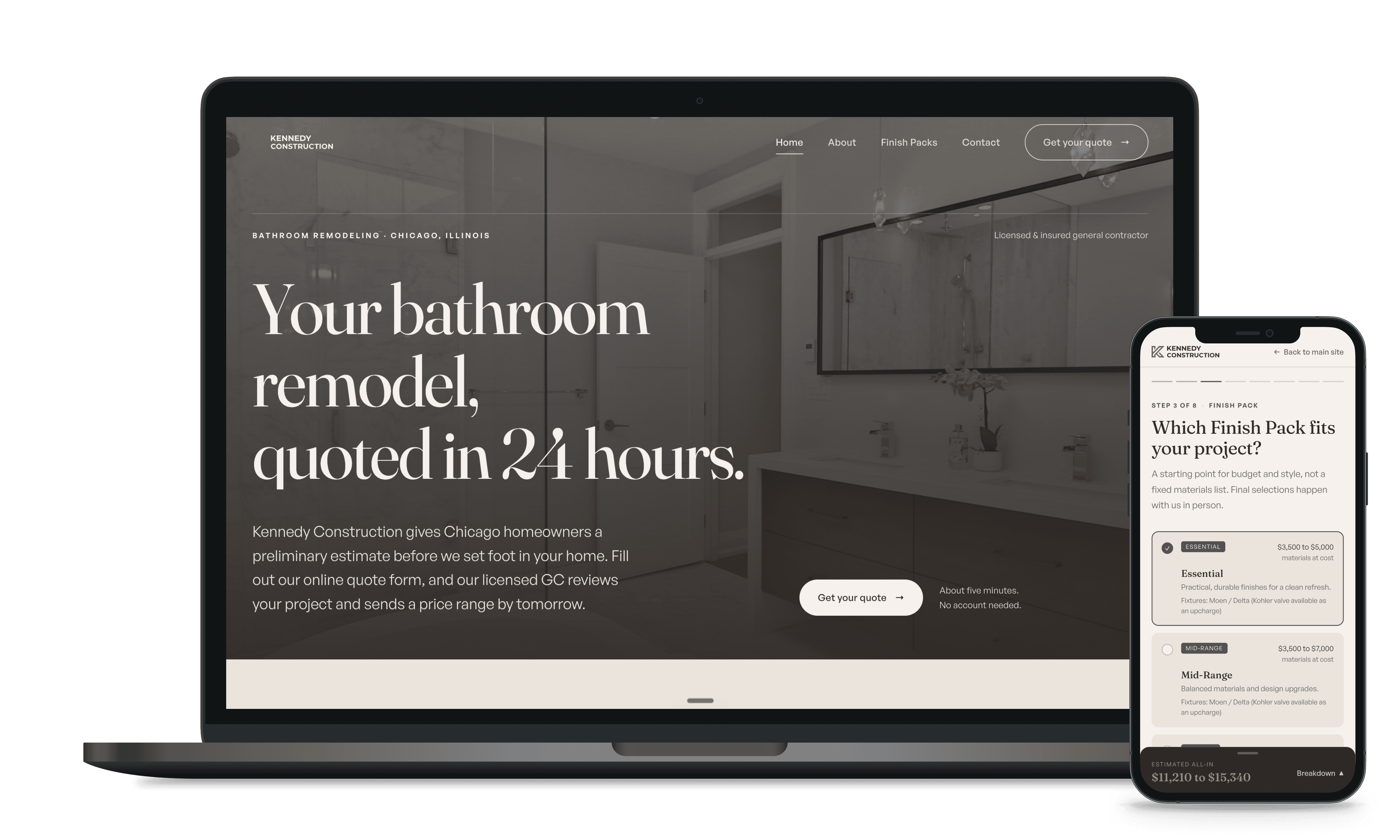
Kennedy Construction is a live business I co-founded with my brother Justin, a licensed general contractor. Justin owns construction and operations. The entire digital product is mine. The figures below describe the digital work.
Impact at a Glance
turnaround
A reviewed preliminary estimate, before anyone visits the home.
the build
End to End
Brand, site, live estimate tool, and the automation behind it, designed and built solo.
quality bar
100/100
Lighthouse SEO and Accessibility on the shipped marketing site.
00 – about my role
Co-founder and product lead for everything digital. I established the brand and design system, then designed and built the whole customer-facing product on top: the UX, all the copy, the information architecture, the front end, and the automation that moves a lead into the business. I am a designer by trade, not an engineer. I built the software with AI coding agents against a design system I set first.
Most remodelers won't talk price until they have been to your house twice. I built the business around giving it up front.
what I owned
Product and UX Strategy
Brand and Design System
Information Architecture
UX Writing
Front-end Build
Operations Automation.
Justin owns the build, the trades, and every client consultation. Everything a customer sees online is mine.
Role
Co-Founder
Product Lead
client
Kennedy Construction, a residential bathroom remodeling company in Chicago and the surrounding suburbs. A two-person, family-run business.
timeline
January 2026 to present. The marketing site went live on the real domain in July 2026 and has been taking leads since.
01 – situation
Remodeling has a trust problem, and it starts before a single wall comes down.
A homeowner who wants to redo a bathroom cannot get a straight answer on what it will cost. Most contractors will not give a real number until they have visited the house, sometimes twice, so a price is something the homeowner earns only after giving up time and access. When a number does arrive, it is often one lump sum with no breakdown, padded to cover the unknowns or set up to grow through change orders once the work starts. The planning phase, before any construction, is the single most stressful part of a remodel, and it is the part nobody helps with.
That is the gap Kennedy Construction was built to close. Justin is a strong general contractor. The problem was never the building. It was the experience around the building, the part of the trade that loses people, and the part a designer could actually fix.
Constraints
Two People, No Team
A two-person family business. Justin, a non-technical operator, runs it day to day.
Near-Zero Budget
Near-zero budget and no engineering team.
A Designer Building Software
A designer, not an engineer, building the software.
No Promises We Can't Keep
Every promise on the site has to be backed by something Justin can actually deliver today.
02 – Objective
Turn the worst part of the category into the product.
for the homeowners
Give a real, itemized price range in about five minutes, with no site visit and no account, and take the anxiety out of the planning phase by leading with the number instead of hiding it.
For the Business
Make the front end the differentiator. Qualify leads before Justin spends an evening on a house call, start every project with an informed homeowner, and build something a non-technical operator can run alone and that will scale past the two of us.
The idea is easy to explain, which is part of why it lands. By now everyone knows what it feels like to build a car online: you choose your options, you watch the price move, and you know exactly what you are getting before you ever set foot in a dealership. Kennedy takes that same familiar idea, a live pricing tool, and brings it somewhere it has never been, a residential bathroom remodel. The mental model is borrowed. The place is new.
03 – product decisions
Research first. Design second. A roadmap built to outlast the launch.
Each move below is a product decision, shown with the process artifact that proves it and the trade-off worth pulling out. The full threads live on their own pages, linked where they belong.
Positioning
Every competitor hid the price. I made it the product.
I read the five strongest remodelers in Chicago page by page, and every one did the same thing: no quote until they visited your home. That was not a feature gap to close, it was the entire opening. The bet was to do the one thing the category refused to do.


I read the five strongest remodelers in Chicago page by page, and every one did the same thing: no quote until they visited your home. That was not a feature gap to close, it was the entire opening. The bet was to do the one thing the category refused to do.
discovery
The planning phase is the part nobody helps with. That is where I aimed the product.
Mapping the journey stage by stage flagged the two moments where the homeowner feels most in the dark: the planning stretch before the work starts, and the days a crew is tearing out their bathroom. The planning phase is the bigger black box and the part no contractor helps with, so that is where the product starts. Giving them a straight number up front is the first fix. Making the build itself less stressful to live through is the next one we are working on.

The homeowner's confidence across the whole journey. It bottoms out in the planning phase, before anyone helps, which is exactly where the product starts.
Go Deeper: The Customer Journey.
Every stage of the homeowner's experience, with its emotions and pain points, mapped in full.
scope
I built the easy version first, and building it is how I found its ceiling.
Webflow and Tally were the fast, cheap, sensible first move, and building them is how I found the ceiling. I had the runway to do it right: a new business still standing up its LLC and paperwork bought me a couple of months, so instead of shipping the quick version and living with it, I rebuilt the intake as custom software that keeps the promise and can scale. That is the central call, short-term delivery against long-term vision.


The same first question, three months apart. The form collects it and goes quiet. The tool answers with a number.
Go Deeper: The Build Story.
Webflow and Tally to a custom configurator: the limits I hit, the migration assessment, and the vision prototype.
pricing configurator UX
The price had to be something you watch happen, not something you are handed.
The whole point is that the price is something you watch happen, not a number handed to you at the end. The sharpest call inside that was refusing to punish uncertainty. An early version zeroed out the estimate for a "not sure," which killed exactly the leads we most wanted to keep, so now a "not sure" returns a sensible default and a real number. The price never disappears.
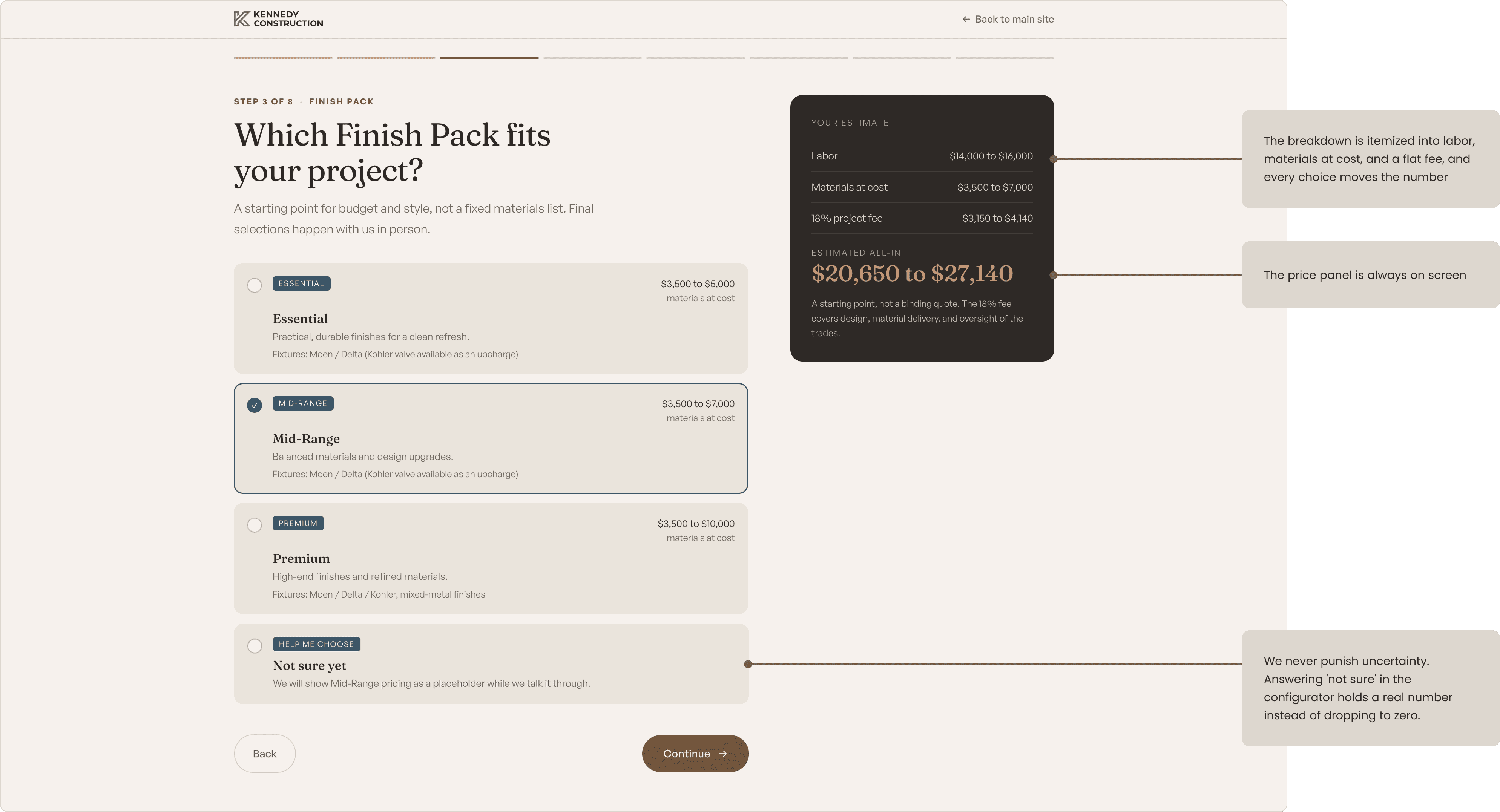
The price panel stays on screen and itemized. Every choice moves it in real time, the way building a car online does.
automation
One checkbox turns a lead into a proposal. It drafts, it never sends.
This whole thing falls apart if the back end is manual. Justin is not technical, so every lead lands in a Google Sheet he already uses, and one checkbox builds the branded estimate PDF and a ready-to-send email. The real design decision was not the automation, it was choosing what to hand the machine and what to keep with the person: the machine assembles, Justin confirms the price and sends. A wrong price going out on its own would hurt the business, so it never sends until Justin says so.

One checkbox does the assembly. The two steps that carry risk, confirming the price and sending, stay with Justin.
Go Deeper: The Session Loop.
How a solo, non-technical founder shipped months of work with AI by turning a forgetful tool into a continuous teammate.
brand
I rebuilt the brand from cool to warm, because a remodel this big comes down to trust, not just good work.
Competence is table stakes at this price. What actually wins the job is whether a homeowner trusts you in their house, and the first version of the brand read cool and clinical, more software tool than craftsman. So I repositioned it warm: same layout and type, a warmer palette and voice, so the whole thing feels like someone you would let in your home. I set that system before I wrote a line of code and it stayed the source of truth for every screen, which is also why one person could ship all of it.

Same layout, two temperatures. v1 read like a software tool. v2 reads like someone you would trust in your home.
Go Deeper: The Brand & Identity System
The visual system I built first and used as the source of truth for every screen.
04 – Results
Kennedy Construction is live, on its real domain, and taking leads. It is instrumented with analytics and session recording so the experience keeps improving on evidence, not guesses.
The MVP launched with confidence because every design decision traced back to what advisors told us. After launch, I partnered with marketing and product to define the post-MVP roadmap for content and features, grounded in the same research.
By the Numbers
Fund flows
Combined GPIX and GPIC flows since October 2025. Monthly averages up 50% and 33% post-campaign.
Trade Volume
Monthly average trading volume across both funds, totaling 1.6M trades post-campaign.
Sales leads
Total leads generated through engagement on the Active ETF hub, feeding directly into the sales pipeline.
net-new pipeline
Of leads were net-new or dormant prospects, with no sales-quality interaction in the prior six months.
Key Outcomes
Research-Driven MVP
Content hierarchy, component prioritization, and feature scope all came from advisor and ETF specialist interviews. The team shipped what users asked for, not what internal stakeholders assumed.
Scalable Roadmap
A comprehensive redirect strategy for 24,000+ pages maintained discoverability and SEO value during cutover.
Lead Generation Model
The site tracks engagement, nurtures users past scoring thresholds, and passes qualified leads to sales. Digital experience feeds the pipeline directly.
Proof Point for the Firm
This project showed leadership that front-loading research delivers business results: more qualified leads, stronger positioning, and a roadmap grounded in real user needs.